
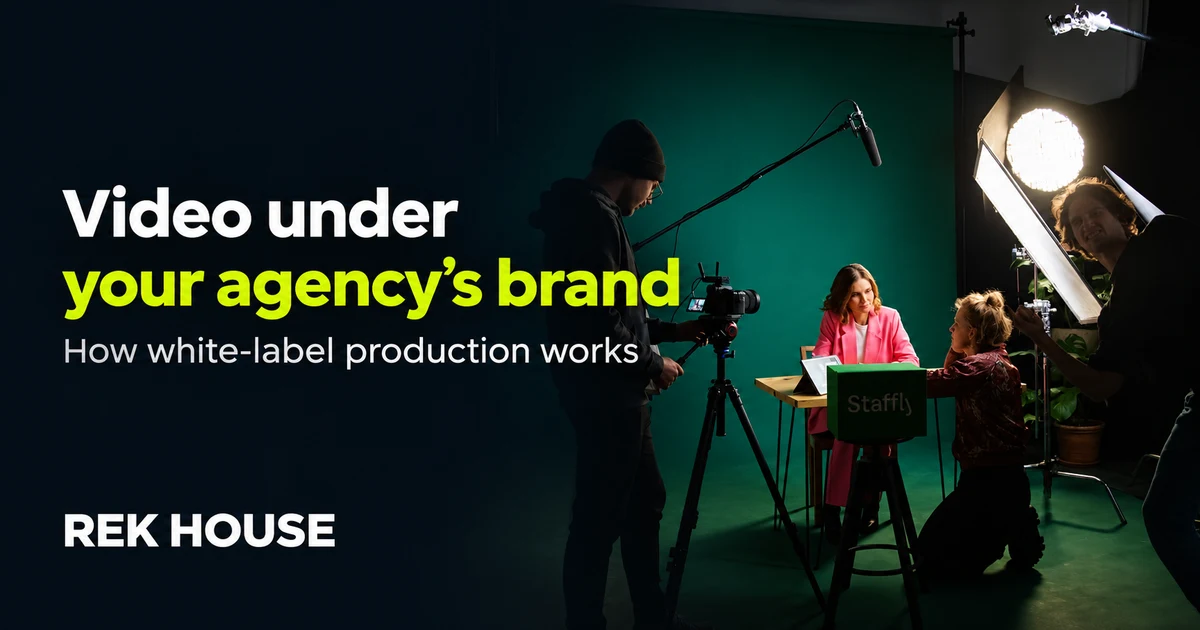
White-label video production lets an agency commission an external team and deliver the finished video to its client under the agency's own brand. The agency manages the commercial relationship, while the production partner handles the agreed scope. That can mean the entire production or a specific stage, such as filming and editing.
For an account manager, the most important questions usually arise before the proposal goes out: who will write the script, how should the budget be calculated and who will consolidate the client's feedback? The answers determine how much work stays with the agency and whether the project remains profitable.
Below, you will find a breakdown of responsibilities, a quoting checklist and a message template for contacting a producer. We also explain how Rek House works with agencies and what our publicly documented projects demonstrate.
What does white-label mean in video production?
White-label means that a partner provides a service for an agency, and the finished work is presented as part of the agency's offering. In video production, this can cover the whole process or a particular stage, such as filming and editing.
Subcontracting can be transparent: the client knows which studio is producing the video. In a white-label arrangement, the producer works under the agency's brand, with the crew's introduction and the materials' branding agreed for the project. Hiring an external camera crew alone does not establish a white-label arrangement.
At Rek House, we offer video production for marketing agencies, including work under their own brand. We can start with a single project or agree an ongoing production partnership.
When does an agency need a production partner?
The most obvious situation is a campaign that requires skills beyond the team's existing resources. Availability is another reason: your own crew is already working on another production, and the client's deadline cannot move.
An established partner can also help earlier, while you are preparing a proposal. A concept that looks convincing in a presentation still has to fit the budget and schedule. Check its feasibility before making a commitment to the client.
This is particularly useful for product videos and explainers or case study videos. Access to the product and contributors directly affects what the film can show.
How do you price video production for an agency client?
Start by identifying the project's stage. An initial pitch budget may rely on assumptions that still need to be confirmed. A quote for an approved script should already specify the deliverables and exclusions. Make clear which information comes from the client and which elements are still agency proposals.
What should you include in a request for a quote?
- The video's purpose and audience: the question it should answer and the people it needs to reach.
- The agency's scope: whether you will provide a finished script or also need concept development and help preparing what contributors will say.
- Filming arrangements: available contributors, locations and proposed shoot dates.
- The deliverables: number of videos, approximate running times, aspect ratios and language versions.
- Distribution: the website, social channels or paid campaign; also the duration and territory of use where relevant to licensing.
- The delivery deadline and production budget excluding VAT, separated from the campaign's other costs.
If the scope is not yet complete, send a video production brief that flags the unknowns. It is easier to agree a feasible approach at this stage than to revise a proposal after making a promise to the client.
What has the biggest effect on cost?
Price primarily reflects the work needed to realise the idea. A second location may require another trip. Casting an actor means budgeting for their fee and the agreed use of their likeness. A vertical cut with a different opening needs its own edit, while an English version may require translation and a voice-over recording.
Ask for a breakdown of preparation, filming and post-production. Check external expenses, feedback rounds and the terms for additional work separately. A finished video's length is not enough to compare two quotes. Our guide to how much a promotional video costs explains indicative budgets for our productions and how to compare their scope.
How should you account for the agency's fee?
The producer's price is the cost of buying the service. The agency also needs to charge for its own work, including client service and managing approvals. Agree this before sending the proposal, along with the terms for handling additional requests.
Here is an illustrative calculation, rather than a Rek House quote: production costs PLN 12,000 excluding VAT, and the agency sells it for PLN 16,000 excluding VAT. The difference is PLN 4,000. That represents a margin of 25% of the selling price and a markup of approximately 33.3% on the purchase cost. The PLN 4,000 still needs to cover the agency's work and other expenses. The entire difference is not profit.
If the target is a 30% margin after deducting only the production purchase cost, calculate the selling price as 12,000 / (1 − 0.30), or approximately PLN 17,143 excluding VAT. The profitability of the whole project also depends on the agency's own costs.
Who is responsible for what: the agency, producer and client?
The breakdown below is a suggested way to organise a project. Name the responsible people in the proposal and adapt the scope to the brief. In particular, distinguish preparing content from approving it.
| Stage | Agency and client | Production partner |
|---|---|---|
| Brief and objective | The agency clarifies the objective with the client and supplies the materials. | Checks feasibility and identifies missing information. |
| Concept and script | The agency manages client approval and identifies who will write the script. | Develops the concept and script if included in the commission. |
| Pre-production | The client confirms contributors and access to locations; the agency consolidates the arrangements. | Plans the crew and shoot, arranging the elements specified in the proposal. |
| Filming and editing | The agency approves the direction; the client checks factual accuracy. | Films the agreed material and prepares an edit. |
| Feedback and changes | The agency supplies one consolidated feedback list and approves additions to the scope. | Makes revisions within the agreed scope and quotes for additional work. |
| Sign-off and publication | The agency confirms acceptance; the client publishes within the agreed terms of use. | Supplies the specified files and information about usage restrictions. |
Appoint one day-to-day contact on each side and identify who can approve an additional expense. The producer should receive the agency's decisions rather than have to resolve conflicting comments from several client departments.
How do you protect the agency's client relationship in a white-label arrangement?
Before the first interaction, agree how the crew will be introduced and who will lead the conversation. Routing every technical question through an account manager is not always necessary. Direct logistical contact can make filming easier to prepare, provided the agency knows what has been agreed.
At Rek House, we sign NDAs and can work under the agency's brand. Before starting, we need to clarify who can access the files and how information will be exchanged with the end client.
Record the rules for making direct proposals to the client and for subsequent commercial contact. Separately agree whether the producer may disclose the client's name or show the video in its portfolio. Permission for the brand to publish the finished film does not automatically determine whether the subcontractor can use it.
What should you agree about rights and files?
Before commissioning the production, describe how the end client needs to be able to use the video. The rights and licences should match the planned distribution, including paid advertising. Check restrictions on music and third-party materials where they are part of the production.
List the files that will be handed over. Finished exports, raw footage and editing project files are different deliverables. If the agency wants to create further versions independently, include that requirement in the brief and proposal. Agree how long the footage will be retained, too.
How do you plan the schedule and revisions to stay within budget?
The schedule should allow for the agency's internal review as well as client approval. A first-edit deadline alone does not establish when the finished film will be ready to publish. Our guide to promotional video production stages explains how the individual stages are organised.
Approve the main message and script before filming. Specify the number of feedback rounds, deadlines for comments and the person responsible for final sign-off in the proposal. A round should mean one consolidated list of comments, rather than a series of separate messages from successive reviewers.
Distinguish a revision within the commission from additional work. Changing a caption and filming another contributor require different amounts of effort. If a new topic or another video is added after script approval, first confirm the effect on cost and delivery. Do not assume that a delayed feedback deadline will leave the publication date unchanged.
What does an agency partnership look like in practice? Rek House examples
For Tigers, we co-developed the concept for a series of five videos promoting training courses. The agency's experts appeared in humorous scenes. Our scope covered shoot preparation and filming, followed by editing and animation. See the Tigers video campaign, including the finished episodes and an explanation of our role.
This was a publicly credited production for the agency itself, demonstrating a creative and production partnership. We do not present it as an anonymous white-label project for an end client.
Konceptika's public testimonial provides an example of a production for an agency's client. Its founder describes a project for an international optical company and how Rek House translated the brief into practical filmmaking solutions. The reference confirms our experience of this arrangement without disclosing the budget or contractual details. You can read it among our agency partner testimonials.
Before choosing a supplier, look for a comparable scope: did the producer develop the idea, organise the shoot or handle the entire production? This makes it easier to assess how much work they will actually take off your agency's team.
What does agency support after publication include?
When choosing a production partner for your agency, ask about work after the launch as well. Once a video has been delivered, you may need a version for a new campaign or an update to reflect the client's offer. At Rek House, we can help with further materials; the scope of that support needs to be agreed for the project.
Record who is responsible for storing the footage and how long it will remain available. Also define how additional exports and updates can be commissioned. This lets the next account manager know where to find the materials and whom to contact about a change.
Separate technical adaptations from new creative work. Exporting a file in a different codec is a different task from producing a vertical ad with a new opening and a different sequence of shots. Before the agency promises the client one more cutdown, confirm its cost and an available delivery date.
If the agency runs an advertising campaign, performance insights can inform the brief for subsequent video versions. Campaign analysis and optimisation should have a designated owner. Commissioning production alone does not define the scope of media services.
How should you compare potential production partners?
Watch work that addresses a similar task, rather than only the most impressive showreel. Ask what the supplier's role was: did they handle the whole project or one stage? The video alone does not reveal the quality of their organisation.
Also consider how the partner gathers information. Do they ask about constraints and approvals? Can they explain the assumptions behind the budget? Is it clear who will lead the production? A clear proposal is a useful starting point for assessing how the partnership will work.
Discuss what happens if a date changes or a key contributor becomes unavailable. The appropriate response depends on the project, but it is worth knowing the arrangements before a problem arises.
Before deciding, explore Rek House's work and client testimonials. For a specific commission, we can select examples that match its scale.
An agency checklist before commissioning video production
Before confirming the project, check whether the proposal and brief answer the following questions. Fill in the gaps before work begins.
- Is it clear who will supply the script and who will approve its final version?
- Have you specified the number of deliverables and their formats, including language versions?
- Has the availability of contributors and filming locations been confirmed?
- Does the budget separate production costs, the agency's work and additional expenses?
- Does the schedule allow time for both agency and client feedback?
- Have you recorded the number of revision rounds and the terms for pricing changes to the scope?
- Have you agreed client contact, confidentiality and portfolio rules?
- Do the usage rights and list of files to be delivered match the intended use?
A message template for contacting a production partner
“For a client in [industry], we are planning [type and number of deliverables]. We want to reach [audience] and help them [the video's purpose]. We will use the materials in [channels, paid advertising or organic distribution]. The project is at [pitch / approved project] stage. Our agency will handle [agency scope], and we need the producer to provide [scope]. Available locations and contributors: [description]. Publication deadline: [date]. Production budget: PLN [range] excluding VAT. The partnership should be [white-label / publicly credited].”
Attach the script if one already exists, along with reference videos and a short explanation of what makes them relevant. If information cannot yet be shared, mention the need to agree confidentiality before passing on the brief.
Have a client brief? Let's define the production scope
Send the project outline to k.golebiowski@rekhouse.pl. Include the deadline and production budget, and say whether you need white-label delivery. You can also contact us at pitch stage, before the client approves a detailed script.
For the first conversation, bring a list of the materials you need and explain which tasks will stay with the agency. Our page for marketing agencies describes the partnership model and available scopes.