
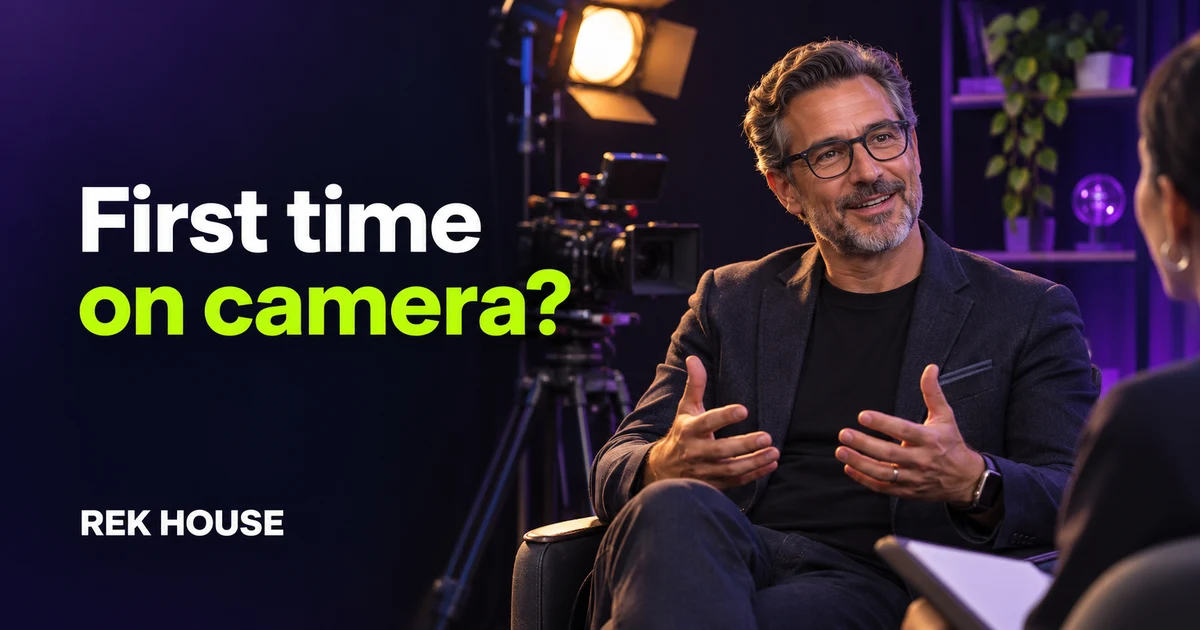
You can spend an hour explaining your work to a client. Then you stand in front of a camera and suddenly struggle to start the first sentence. Where should you look? What should you do with your hands? And is that really what your voice sounds like?
A company video does not require a background in presenting. You need to know what you want the audience to understand, and the crew should help you say it. At Rek House, we also work with specialists whose main job is their subject, with filming an occasional part of it. This guide explains how to prepare for a business interview and what support to expect from the people directing the shoot.
How should you prepare to speak on camera?
Start with one question: what should the viewer understand after watching? Write down your answer in your own words and choose an example from your work. Tell the crew if this is your first recording or something worries you. Before filming, agree whether you will speak to an interviewer or directly into the lens. You can start preparing without writing a speech several pages long.
For an edited interview, you do not have to deliver a flawless answer from start to finish. You can pause and repeat a section. Live broadcasts require different preparation because mistakes cannot be cut afterwards. This guide mainly covers recordings that will be edited.
1. Prepare the point, rather than memorising every sentence
When asked to introduce your company, it is easy to try to include everything: its history, products, strengths and plans. Your customer may simply want to know whether you solve the problem they are dealing with. That is a useful place to start.
Instead of writing “Our company provides comprehensive solutions that optimise processes”, ask which process you improve. What was difficult before? What does the work look like afterwards? A specific situation is easier to describe in your own words.
An illustrative example: “Previously, someone entered order details into the system manually. Now the system imports them automatically, and the employee only checks exceptions.” This also gives the crew ideas for supporting footage. Any figures or outcomes used in an actual client video need to be verified first.
Say your answer aloud. If you run out of breath halfway through a sentence, shorten it. If you would never use a phrase in a client conversation, consider whether the film needs it. Simplifying technical content must preserve its meaning, so the person responsible for accuracy should review the final wording.
2. Choose a format that suits the person and the message
Speaking alone into the lens is only one option. If talking without someone to respond to feels difficult, consider an interview. The interviewer asks a question and can request an example or revisit a point that needs explaining.
If demonstrating comes more easily than describing, build the recording around using a product, operating a machine or working through an application. The format should serve the film's purpose and suit the contributor.
When is a teleprompter useful?
A teleprompter displays the script in line with the camera lens. It can help when precise wording matters, such as an approved leadership statement. Try it beforehand to see whether reading this way suits you.
A teleprompter script should sound like speech. Long sentences and formal language make delivery harder. During rehearsal, adjust the scrolling speed to the speaker. For an expert interview, questions and brief notes may be more comfortable.
3. Agree what your involvement will look like
Ask which part of the day is reserved for your recording and what needs to be captured. Discuss whether the interviewer's questions will remain in the film, which materials to bring and who will approve the content.
If you are organising filming from marketing, send contributors their topics and approximate time slots. Explain who the audience is and where the film will appear. “We are filming tomorrow, please prepare” leaves too much unclear. Allow time for fitting the microphone and a rehearsal. Avoid booking an important meeting immediately after the chief executive's scheduled finish, because any delay will create pressure.
Our guide to writing a video brief helps define the purpose and scope. Agreeing these points before filming lets you focus on the conversation on the day.
4. Ask for specific direction on set
“Be natural” is not particularly helpful when several people are watching and there is a camera in front of you. Specific instructions work better: “Explain it as you would to a client” or “Let's return to that implementation example”. The director should give you guidance you can act on. If a comment is unclear, ask what it means. You should not have to guess what the crew wants.
Where should you look, and what should you do with your hands?
Agree your eye line with the director. In an interview, you usually look at the interviewer beside the camera. When addressing the viewer directly, you look into the lens. Establish this before you start answering.
If you usually gesture, you do not need to become a statue for the recording. You can also rest your hands comfortably. The crew will help position you within the frame and check that movement does not create microphone noise. Once that is settled, focus on the conversation. Monitoring every gesture while choosing every word can make explaining your point harder.
What should you do if you make a mistake?
Pause briefly and return to the beginning of the sentence or thought. Repeating a complete, logical section usually gives the editor more options than correcting one word in the middle. The director will help you choose where to restart.
If you cannot recall a number or name, say so and check it first. Editing can remove a verbal mistake, but it should not replace fact-checking.
How Rek House supports experts: the HOYA example
When producing expert videos for HOYA Lens Poland, we combine script preparation with directing the people appearing on camera. HOYA's team provides subject expertise and checks the content. Rek House prepares the production and helps communicate that knowledge in a short format.
During filming, contributors receive direction suited to their experience. We then handle post-production. This division means the expert does not also have to manage filming and editing while concentrating on the subject. Our HOYA Lens Poland project describes the scope of the collaboration.
5. Agree the editing and approval process
The finished film is selected and arranged footage. Repetitions and pauses can be removed, and parts of an answer can be illustrated with a product, process footage or graphics. A single hesitation does not necessarily ruin a useful take.
Do not leave everything to editing, though. If an essential explanation was never recorded, the editor cannot assemble it. Before wrapping up, check with the interviewer that you have answered the film's main question. Recording one extra sentence while the contributor still has a microphone is easier than arranging another session.
Before production, agree who approves the film and how many feedback rounds are included. If you manage the project from marketing, collect comments from the relevant people and send the crew one consolidated list. Conflicting feedback arriving separately from several departments slows the work down. Agree whether contributors will review their answers and when the content will be checked for accuracy.
Our guide to promotional video production stages explains the wider process. Filming is one stage, with preparation and approval each requiring their own work.
What if you are worried about reactions after publication?
Concern about comments goes beyond the recording itself. Before filming, find out where the video will appear, who it is for and whether it will run as a paid advertisement.
Ask who will respond to viewers' questions and how the company handles abusive comments. For topics requiring particular precision, agree an additional accuracy review. Preparation helps address foreseeable problems, but it cannot guarantee how an audience will react.
What should you prepare the day before filming?
- Review the film's purpose and your topics. Choose an example to explain your main point.
- Check the figures, names and facts you intend to mention. Identify anything you cannot disclose.
- Agree your outfit with the crew. Fine patterns, noisy fabrics or jewellery may need checking on camera and with the microphone.
- Confirm the location and time. Leave room in your calendar for getting ready to record.
- Tell the director whether you prefer an interview, a standalone statement or a teleprompter rehearsal.
Plan a recording with your experts
Planning an expert video, leadership statement or customer interview? Tell us who will appear and what the audience should understand. We will discuss a format that suits the purpose and the contributors, along with preparation and support on set, so you know what your team will need to handle.
See our work with HOYA Lens Poland, or email k.golebiowski@rekhouse.pl. For regular recording sessions, explore the Rek House video subscription.